
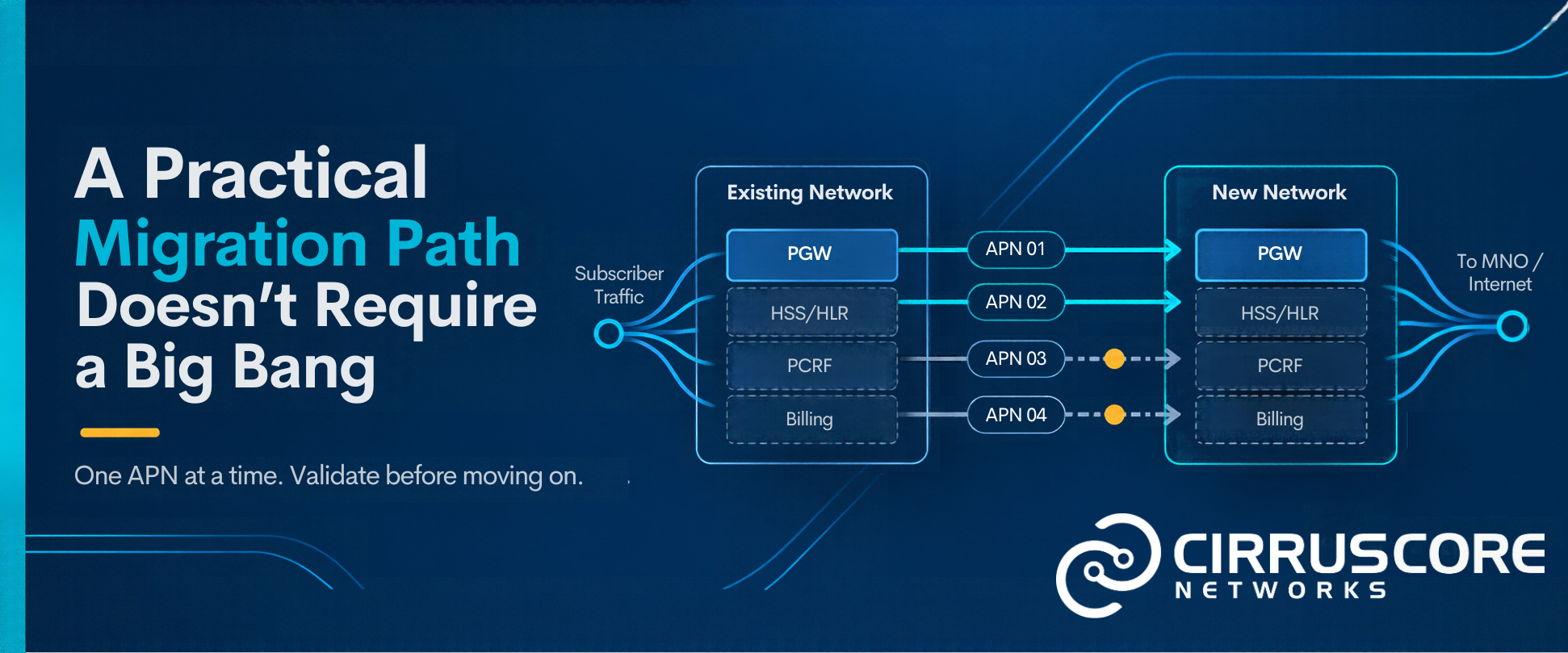
Migrate in Stages, Not in One Move
Move in the right order, validate each stage, and keep customers connected.
10/30/2026
Every operator looking seriously at moving off a core platform asks the same first question: how do we do this without an outage that shows up in customer complaints and churn reports?
The answer is that you don’t migrate a live network in one move. You migrate it in stages, and you validate each stage before the next one is allowed to start. CCN’s migration path for operators moving onto an AxyomCore-based PGW runs in four stages:
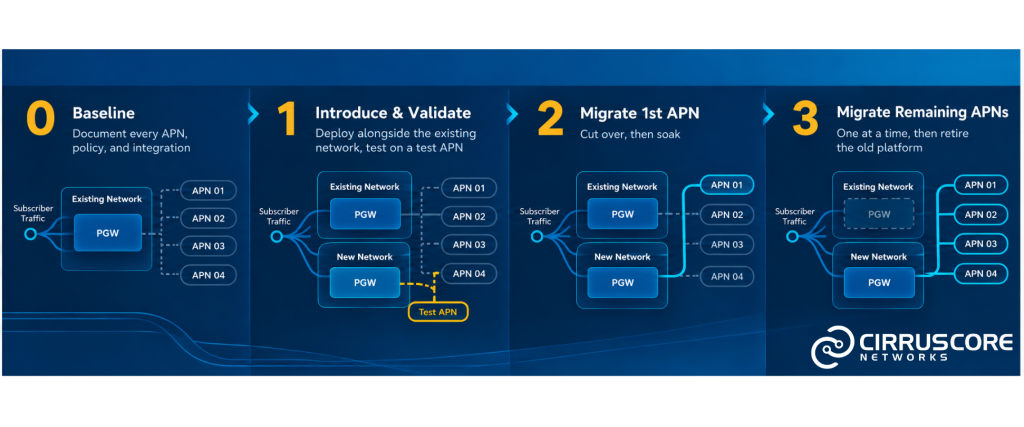
Stage 0 — Baseline. Document the existing network exactly as it runs today. Every APN, every policy, every integration point with HSS, PCRF, and billing. This is the stage most migrations skip, and it’s the reason most migrations run over schedule.
Stage 1 — Introduce and validate. The new PGW is deployed alongside the existing platform, provisioned with the same logic, and validated against a test APN. Gx and Gy integration is confirmed. No live subscriber traffic touches the new platform yet.
Stage 2 — Migrate the first APN. During a planned maintenance window, the first APN is cut over using a DNS S-NAPTR record update, not a hardware swap, not a subscriber-facing change. That APN then runs through a soak period while the remaining APNs stay on the current PGW.
Stage 3 — Migrate the rest, one at a time. Each remaining APN follows the same pattern: cutover, soak, validate, move to the next. The original platform is only decommissioned after the final soak period completes cleanly.
This is not a faster path than a full cut-over. It is a safer one, and for a subscriber base that includes roaming and enterprise contracts with SLA exposure, safer is what actually protects revenue.
The operators who come out of this migration best positioned aren’t the ones who moved fastest. They’re the ones who moved in the right order, with a partner who has already done this migration before.
Planning a move?
We’ll be at Booth 5 at MVNO Nation Europe in Alicante, Nov 3-5, 2026. Bring your APN count and your timeline, and let’s map it out together.